Technology
Translation Proxy Overview
The Easyling Translation Proxy is a server-side layer that sits between your website's origin server and your visitors, translating content in real time and delivering fully localized, indexable pages without requiring changes to your codebase or CMS. Easyling can be seamlessly integrated with any CMS, ERP, PIM system or other business application without plugin installation.

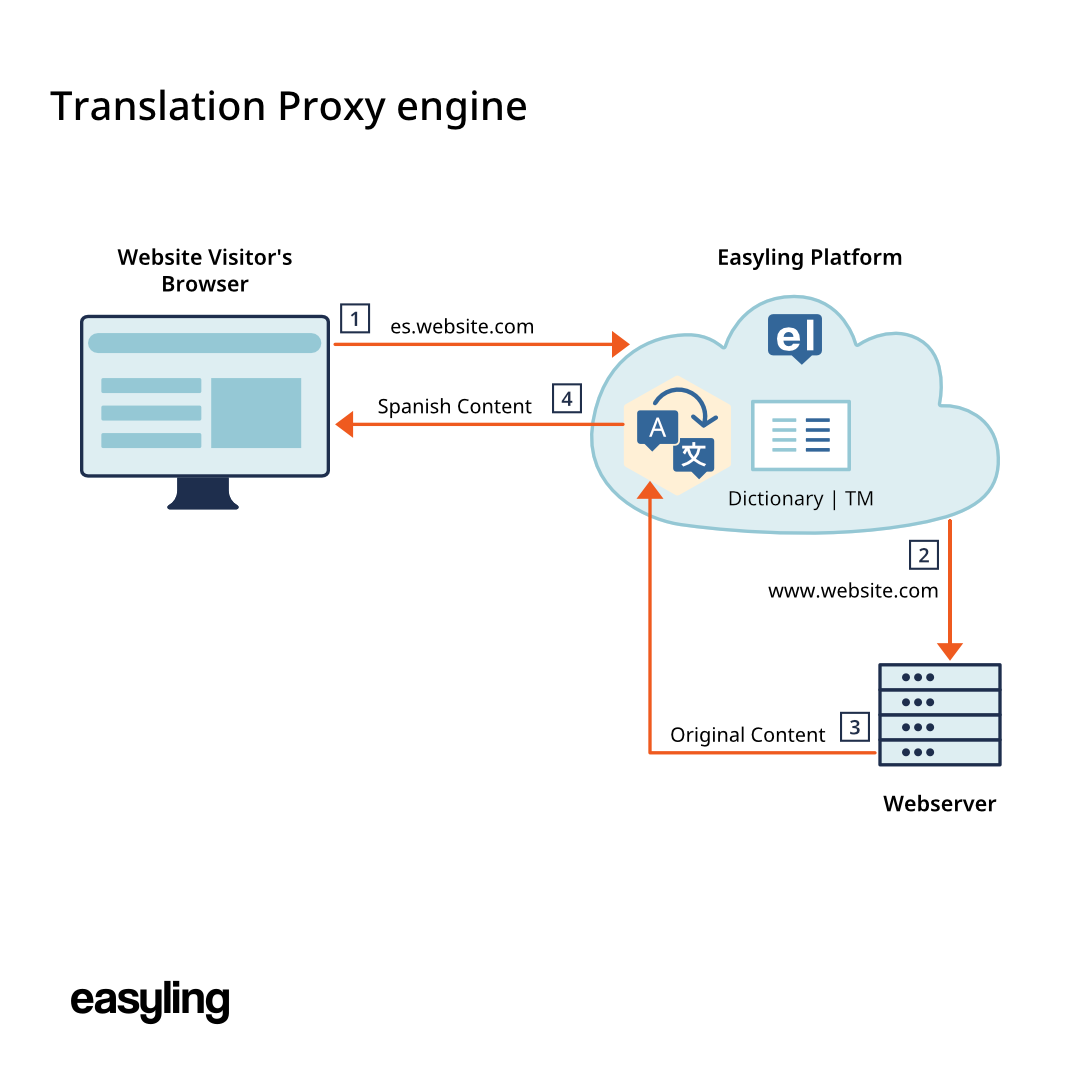
Architecture and request flow
When a visitor requests a translated page, the request is routed to the proxy instead of your origin server. The proxy retrieves the source content from your server, applies the translated content in place of the source strings, and returns the fully rendered, localized page to the browser. Your original site, its codebase, and its database stay untouched throughout.
Content extraction and change detection
Easyling's crawler maps your site and identifies translatable content, and can be scoped to specific sections or a defined list of URLs rather than crawling the entire domain. Once live, source content changes are detected automatically, and updated content is routed back through translation via what we call Continuous Translation Delivery, so localized pages don't silently drift out of sync with the source site.
Dynamic and JavaScript-rendered content
Content generated dynamically in the browser, such as product listings, forms or other interactive elements, is generally supported. Content that never appears in the page's transmitted markup or script, such as certain client-side-only rendering patterns, may require additional configuration to be detected reliably. If your site relies heavily on single-page application architecture or highly dynamic JavaScript rendering, it's worth reviewing your specific setup with our solution team during onboarding.
Publishing methods:
subdirectory vs. subdomain
Easyling supports two publishing methods for the proxy, and the choice affects both setup and SEO outcomes.
Subdirectory publishing serves translated content at a path prefix on your existing domain (for example, yoursite.com/de/ instead of a subdomain). This requires a reverse proxy or CDN in front of your site to route requests correctly, which adds setup complexity, but it's generally the preferred option for multilingual SEO, since search engines tend to treat subdirectories as part of the same root domain's authority.
Subdomain publishing routes translated content through a subdomain (or a separate top-level domain, if preferred) using DNS records pointed at Easyling. This is the faster path to launch, since it requires only a DNS change and no additional infrastructure on your side.
Performance and scalability
The Easyling Translation Proxy runs on Google App Engine, a highly redundant distributed infrastructure with 99.9% availability, with global CDN delivery so translated pages are served from points of presence close to your visitors rather than routed through a single origin. This is designed to keep latency low regardless of where your traffic comes from, and to scale without requiring changes on your end as you add languages or traffic grows.
SEO implementation
Because translated pages are served at their own dedicated URLs (even with translated slugs), they're fully crawlable and indexable by search engines. Easyling handles hreflang tag implementation to signal language and regional targeting, translates metadata (titles, meta descriptions), and can expose or update sitemaps so new translated URLs are discoverable without manual intervention.
Security and compliance
Easyling's Translation Proxy operates independently of your backend, and deployment options can be configured to meet compliance-sensitive requirements, including PCI DSS and HIPAA contexts, depending on your setup. If compliance certification is a hard requirement for your project, confirm current details with our solution team before launch.
Integration and CMS compatibility
The Easyling Translation Proxy is CMS-agnostic. It works the same way whether your site runs on WordPress, Drupal, Shopify, AEM, HubSpot, or a fully custom stack, and requires no plugins or ongoing developer maintenance to keep running. For teams already using CAT tools or a TMS, Easyling integrates directly with platforms like memoQ, Trados, XTM so existing translation workflows don't need to change.
Choosing Between the Translation Proxy and JavaScript Publishing
The translation proxy is one of two publishing modes available in Easyling. If you're deciding between the server-side proxy and client-side JavaScript engine, see the full comparison for a breakdown of setup effort, performance, SEO, and cost tradeoffs between the two.
Technical FAQ
Does using the proxy require ongoing developer involvement? No. Once configured, content detection, translation routing, and delivery run automatically. Developer involvement is generally limited to initial setup and any future changes to your site's architecture.
Does publishing require infrastructure changes on our side? Yes. Subdirectory and subdomain publishing both require configuring a reverse proxy or CDN in front of your site to route requests to the correct path. If your setup does not include a CDN, Easyling can provision one for you.
How does Easyling handle javascript and ajax generated content? Easyling can translate JavaScript variables that are properly named in the code, although this requires knowledge of the language and the code in question. Otherwise, content that is not transmitted with the source code of the page will not be detected and translated out of the box.
Can the proxy handle personalized or session-based content? Yes, the proxy forwards session data for serving personalized content. However, care must be taken to avoid content explosion by accidentally including personalized data. This is typically addressed during onboarding.
What happens to already-indexed pages during setup? Localized URLs are new, dedicated paths or subdomains, so your existing source-language pages and their search rankings aren't affected during setup.
Ready to translate?
Let's pick the right publishing mode for your site
Book a free consultation and our solution experts will help you choose the mode that fits best.