Technology
Website translation modes compared
Easyling translates and publishes your site two ways — a client-side JavaScript engine included with every plan, or a cloud-based Translation Proxy for the best possible localized experience. Here's how each one works, and how to choose.
The short version


Easyling is a scalable, CMS-agnostic website translation platform — no software or plugin to install. We help you integrate it into your environment no matter whatever you run today.
At a glance
Translation modes in Easyling
Every subscription includes JavaScript publishing.
Upgrade to the Translation Proxy when you want the best user experience.
Easyling offers two major website translation modes: an in-browser, JavaScript-based solution and a cloud-based Translation Proxy. Each has its own set of advantages and disadvantages in terms of budget, time, security, performance and SEO implications.
Easyling subscriptions by default include JavaScript publishing, which is a resource-optimized, client-side translation solution, and can be upgraded to the server-side Translation Proxy solution for the best user experience.
Below is a high-level summary of each solution, followed by a comparison of their pros and cons that should be taken into consideration before making your choice on how your website will be translated and published.Need help deciding? You can always ask for advice from the Easyling Team in a free consultation.
JavaScript engine
A resource-optimized, client-side solution. A few lines of code embed in your site and translate text in the visitor's browser — quick to deploy, no backend changes.
Translation Proxy
A seamless translation layer on top of your site, serving content in the requested language from the cloud in real time — for the best localized experience and SEO.
Mode 01 — Client-side
The JavaScript translation engine
A foundational solution for marketing sites and web apps — informational pages, forums, eCommerce, eLearning — as well as highly regulated, privacy-conscious, and intranet use cases. It especially excels on sites and apps driven by JavaScript.
You embed a short JavaScript snippet (a few lines of code) into your website. When a visitor arrives, the original text is replaced with translated text by the code running in their browser.
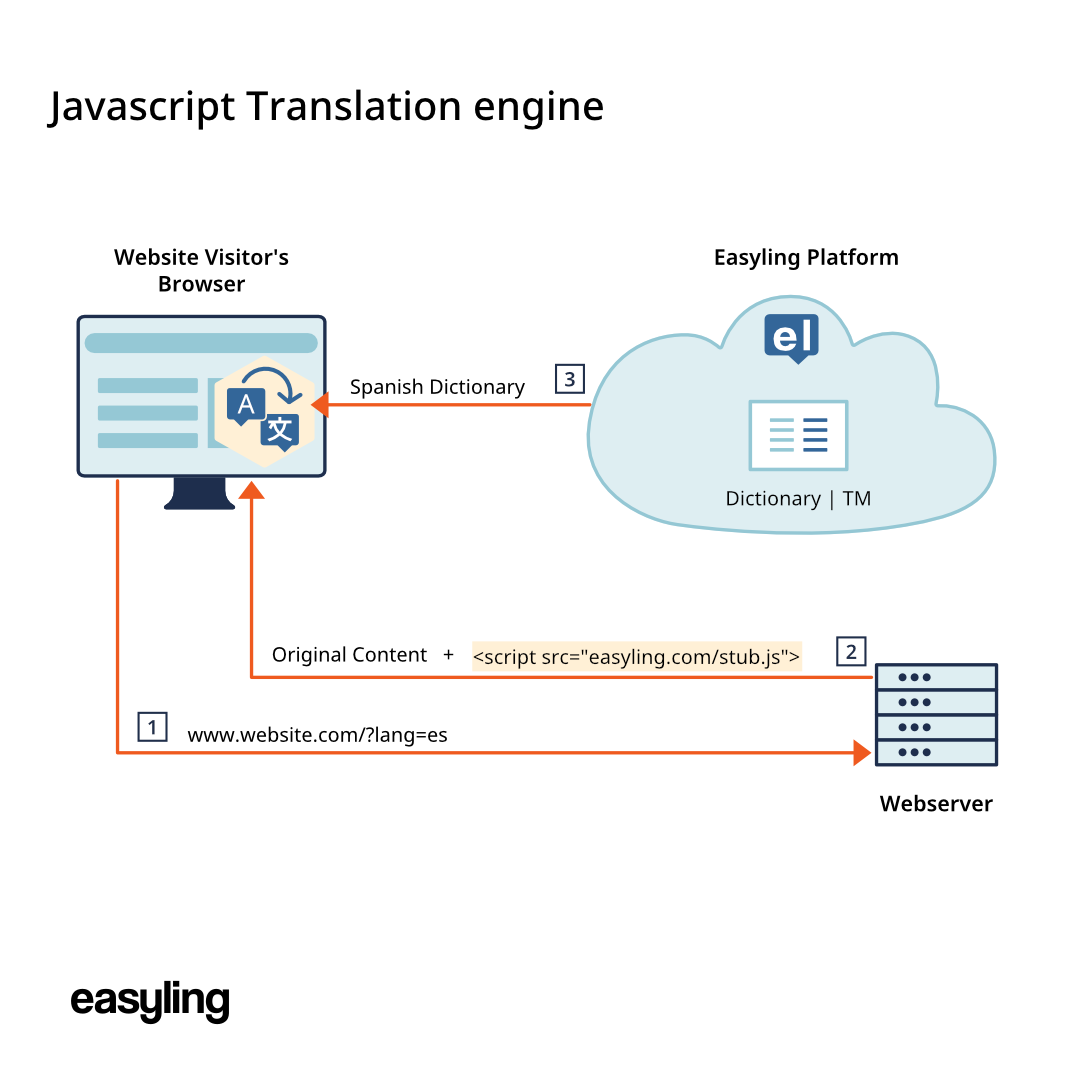
How it works
A visitor requests your page in Spanish (e.g. www.website.com/?lang=es).
Your webserver returns the original English content together with the Easyling translator snippet.
The browser runs the code, downloads the Spanish dictionary from Easyling, and applies the translation on the fly.
Pros
 Cost-effective
- Fast time-to-market
- Quick, out-of-the-box setup
- Minimal changes to the original site
- Handles dynamic content, not just HTML
- Continuous updates as the source changes
- Privacy compliant by design
Cons
 Performance depends on the visitor's device; can slow page loading
- Brief flickering may occur
- Some features need a modern browser
Mode 02 — Server-side
The Translation Proxy
In plain terms, the Translation Proxy is a seamless translation layer on top of your original website that displays content in the language the visitor requests. It delivers the best localized user experience.
The proxy sits between your webserver and the visitor, translating and serving content in real time as it's requested — a middleman serving translations from Easyling's cloud platform.
Need more technical detail? Check the technical overview of the Translation Proxy →
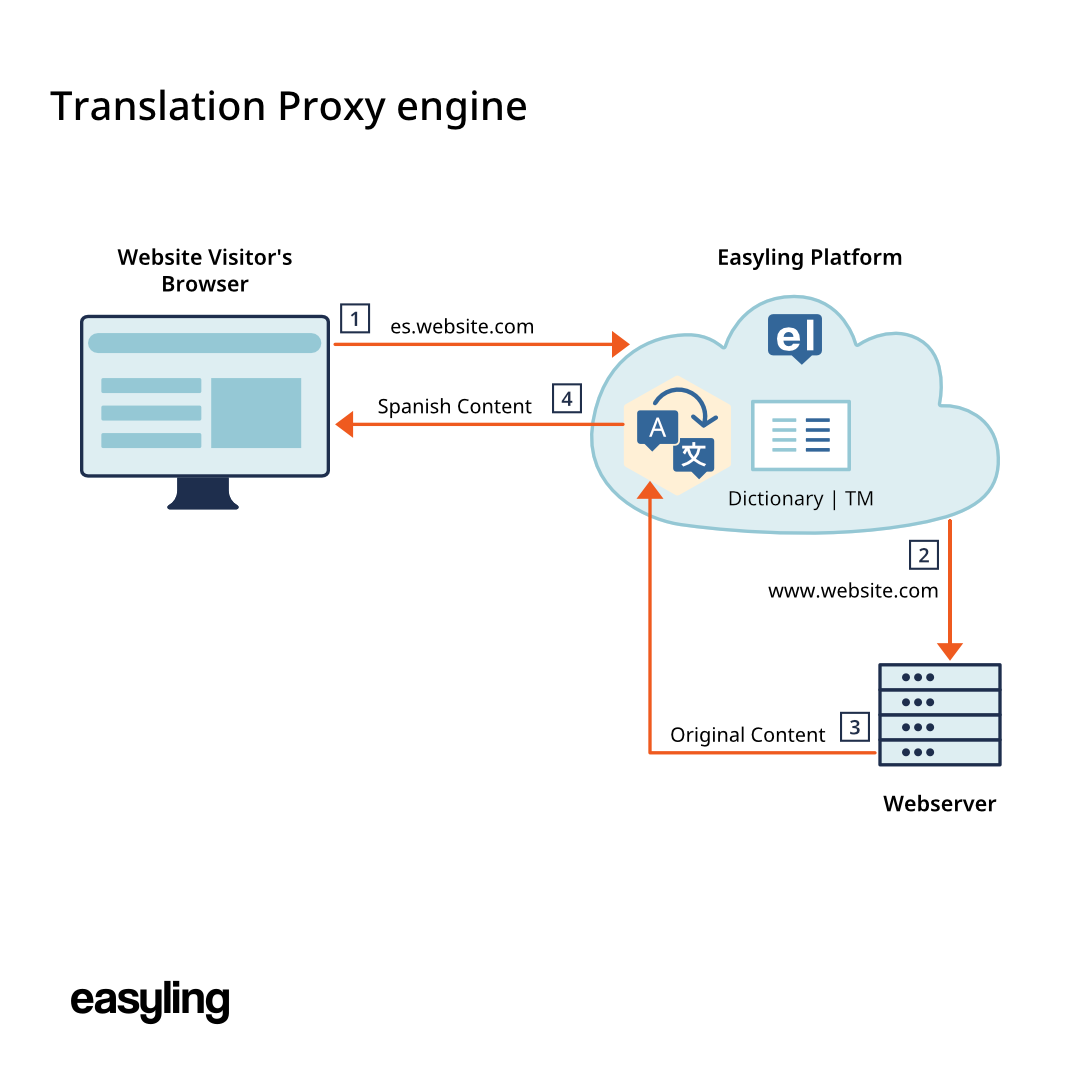
How it works
A visitor requests a page in Spanish (e.g. es.website.com).
The request is routed through the Easyling platform to your original webserver.
Your webserver sends back the original content.
Easyling translates it on the fly in the cloud and serves the finished Spanish page to the browser.
Pros
- Best possible localized experience
- Full transcreation & content customization
- Ultra-scalable infrastructure
- Ultra-low latency, no flickering
- International SEO-friendly by design
- Subdirectory or subdomain publishing
- URL translation
- Search in translated pages
- PCI DSS & HIPAA compliant
Cons
- Complex setup — needs experts
- Relatively higher cost
- Traffic routes through an additional service layer
Side by side
Compare the two modes
Budget, time, security, performance and SEO — the trade-offs worth weighing before you choose.
| Consideration |  JavaScript engine JavaScript engine |
 Translation Proxy Translation Proxy |
|---|---|---|
| Setup | Out-of-the-box, minimal effort, expert-assisted onboarding | Expert-led configuration |
| Time-to-market | Fast | Longer initial setup |
| Budget | Cost-effective — included in every plan | Higher — available as an upgrade |
| Performance | Relies on visitor's device | Ultra-low latency, no flickering |
| SEO | Limited by nature — add-ons available | International SEO-friendly by design |
| Publishing URL | Language parameter on your domain | Subdirectory or subdomain |
| Scalability | Scales for most sites and web apps | Ultra-scalable, world-class CDN |
| Compliance | Privacy compliant by design | PCI DSS & HIPAA compliant |
| AI and NMT translation | Included | Included |
| Term extraction | Included | Included |
| Glossaries | Included | Included |
| Translation Memory | Included | Included |
| Human control | Review and edit | Review and edit |
Which is right for you?
Pick the mode that fits your goals

Choose JavaScript if…
 You want to go live fast
- Budget and speed matter most right now
- Your site is JavaScript-driven or app-like
- You have privacy-conscious or intranet content

Choose the Translation Proxy if…
- You want the best possible user experience
- You need transcreation & region-specific content
- You expect high traffic across many markets
- Compliance (PCI DSS, HIPAA) matters
Not sure which fits? Ask the Easyling team →
Ready to translate?
Let's pick the right publishing mode for your site
Book a free consultation and our solution experts will help you choose the mode that fits best.